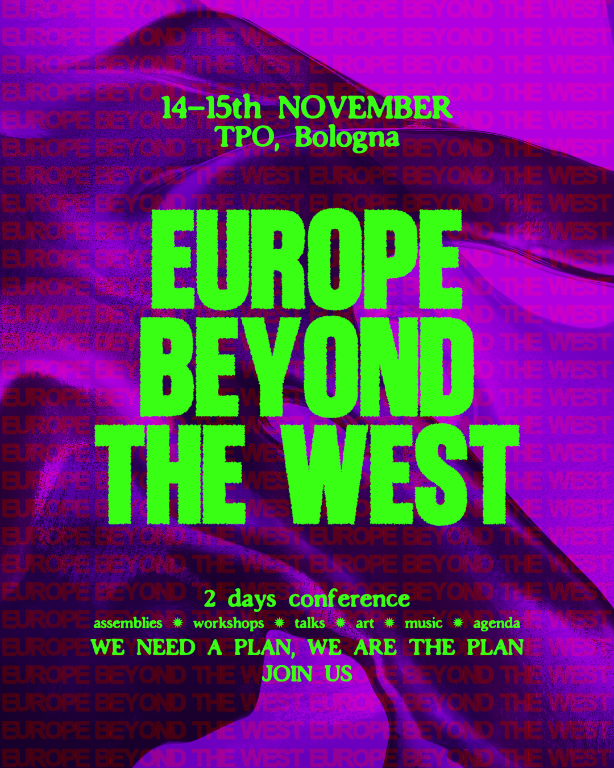
On 14-15 November, in Bologna, we call upon a multitude of rebels and democrats who recognize in this European space-time an opportunity to radically transform the existing order. A European congress to conspire together, to confederate our struggles, knowledge and territories, and to begin building our Europe of the future.
We live in a chaotic era in which the global order once guaranteed by U.S. hegemony has disintegrated, and in which capitalism has assumed a commanding role over society, labor, territories, resources, and bodies through an increasingly algorithmic and automated management of value extraction and accumulation, with data and AI serving as its paradigmatic references. What is taking shape is not simply a geopolitical transition, but a mutation in the very architecture of domination.
In this phase of global capitalism, no state, corporate, techno-oligarchic, or authoritarian religious powers – what we might define as the various subsystems of power – has yet succeeded in establishing itself as the hegemonic leader of this new regime of accumulation. As a result, a violent competition has emerged among these different subsystems, each constantly seeking new spheres of power within the new forms of capitalist command, triggering a regime of global civil war that feeds itself on the ruins it creates. War is no longer the exception to the global order; it is increasingly becoming one of its ordinary mechanisms of regulation.
With the collapse of U.S. hegemony, the institutions (understood in the broadest sense) that sustained that world order have also entered into crisis: NATO, the UN, international law, and, at a deeper level, liberal democracy itself, now incapable of naming what is happening and no longer functional to the operations of the new capitalism. As the founder of Palantir, Peter Thiel, has argued, freedom does not need democracy. Today, even the language of rights, peace, and multilateralism survives largely as an empty shell, invoked by powers that no longer believe in it except as a tactical instrument.
Europe, as we have known it since the end of the Second World War, has also been dragged into this crisis, since the foundations on which it rested have disappeared. Until now, Europe manifested itself as a political and economic institution functional to the global order organized around U.S. hegemony. If this is true, then Europe is facing an unprecedented existential crisis. For the first time, it is being forced to ask what it could become beyond what it has been until now and whether it is capable of overcoming the strategic, military, and ideological dependence that has long tied it to both the United States and the political project of “the West”.
This opens a fundamental question for all those who inhabit this political space: if the foundations of today’s Europe are in crisis, what will be the foundations of Europe’s future? At first glance, we seem to be at a crossroads. On one side are the member states and neoliberal institutions seeking to save the old world by promoting rearmament and austerity policies that would turn the European Union into yet another subsystem of power. On another side are the reactionary and conservative forces that seek to dismantle it in order to build a Europe of sovereign nations. Finally, there are those on the left who retreat into a purely defensive conception of resistance. We believe that none of these paths is adequate to the scale of the transformation underway. None of them confronts the real task before us: not how to preserve Europe as it is, but how to wrest the coming Europe away from those already preparing to govern it against us.
In this phase, which we might heretically describe as constituent, even if it has so far been driven by forces hostile to us, what role should we play? If we wish to continue to exist and pursue a genuine politics of liberation, it is clear that we cannot resign ourselves to these alternatives. Instead, we must seize this existential moment as an opportunity to contest and shape the Europe that is to come, or rather, the Europe that is already taking shape, with the awareness that there is nothing worth defending in the Europe that exists today. The question is not whether a new European order will emerge, but who will shape it, in whose interests, and against whom. Our task is to make our own Europe.
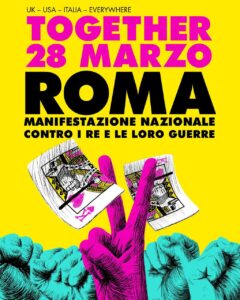
First and foremost, the time has come to say NO to the kings of our age who see this space as a territory to conquer. NO to our governments, which, both in national parliaments and within the Council of Europe, push for nationally based rearmament at the expense of welfare, exposing new generations to the blackmail of military conscription. NO to NATO and to American interference in our economic, political, and defense systems, but also NO to alliances with other imperial powers, whether Russian, Chinese, Iranian, Turkish or Arab, because campism will not save us. NO to the Black International, to far-right, sovereignist, supremacist, and patriarchal forces that use repressive security and remigration as models for governing the society of the future. NO to the interference of techno-oligarchs who believe they can extract wealth from our lives and territories in the form of data and resources. No emancipatory politics can be built by choosing one empire against another, one border regime against another, one war machine against another.
Nevertheless, we do not gather only to denounce the Europe being built above us. We gather to identify the infrastructures through which it is being built, and the points at which they can be interrupted, redirected, or seized. Our task is to transform refusal into organization: against rearmament, border violence, algorithmic command, austerity, and fascism; for social and ecological planning, democratic technology and AI, free movement, transfeminist and anti-racist power, and a confederal Europe of rebellious territories.
Such a Europe would reject fantasies of a pure, white, and Christian identity, recognizing instead its hybrid, mixed, and already cosmopolitan constitution. It would confederate rebellious cities and territories across borders, building institutions of solidarity rather than discipline and redistributing power downward rather than concentrating it ever further above. It would place technological development in the service of life, ecosystems, and the common good, removing the infrastructures of digital life from private monopoly and subjecting them to democratic control. It would become a home for the world’s many diasporas, understanding migration not as a threat to be managed but as a constitutive force of its present and future. In a world at war, it would confront the challenge of sabotaging the war economy without sacrificing anyone, recognizing that there can be no peace without social justice. And it would provide the minimum political scale at which class struggle can once again be organized on the same terrain where capital already operates.
To orient and shape this constituent phase, that is, to contest and make our Europe, we need many different people: scientists, trade unionists, ecologists, engineers, people on the move, students, researchers, racialized people, civil society activists, internationalist militants in diaspora, queer people, MEPs, local councillors from rebellious cities, artists, and humanitarian fleet pirates. We need women, men, and free subjects willing to withdraw their general intellect from war capitalism and the new kings, placing it in common to build our collective project.
The aim of this European congress is, on the one hand, to define a common and shared European political framework around those key issues; and, on the other hand, to identify the first moments of mobilization through which to practice our Europe in the streets. If the Europe of capital, war, and reaction is already organizing itself, then the Europe of liberation must do the same.
Be part of making this conference happen. Whether you’d like to help organise it or simply join as a participant, follow this LINK.
14-15 November 2026
Municipio Sociale TPO
Bologna, Italy