This text has been written by the comrades of Spazi Sociali in Reggio Emilia and Municipi Sociali in Bologna, two political organizations rooted in urban contexts in Emilia-Romagna, Italy. The genealogy of struggles and concepts that we reconstruct in this reflection emerges from a specific perspective: our own, situated within the movements that have developed in Italy, in a broader European and global context. We therefore do not claim to represent a universal history, and we recognize that this reconstruction will not necessarily correspond to the struggles that have emerged elsewhere, including within the European space itself. We nevertheless hope that these theses may stimulate further reflections, perhaps grounded in different perspectives and histories, while contributing to the construction of a shared imaginary of our Europe.
THESES ON EUROPE
The question of Europe has become a central node in the political horizon before us. The historical transformations we are going through are confronting Europe with a profound rupture. Our thesis is the following: Europe has entered a constituent phase.
Premise
Freeing words
We are in a phase of rupture and revolution. We say this by freeing words from the weight of the twentieth century. If we take the terms constituent and revolution and connect them to the use that was made of them in the 20th century, the first question arising is: what exactly are you talking about?
Throughout the 20th century we used to associate the revolution with the communist revolution, and the constituent phase with what comes after a revolutionary rupture. Now, let us free these terms from that burden and bring them closer to their original meaning — classical and scientific — and to real materialism, that is, a quantum materialism. In fact, no historical process develops in a pure, orderly, and linear form.
Constituent and revolution, in their traditional sense, are hybrid, contradictory, and chaotic concepts as they have to do with instability and probability, with the non‑linearity of processes. By doing so, we can return to saying something useful.
A constituent-type phase
To say that we are in a constituent phase for Europe means that, in the short as well as the medium term, neither a right‑wing reaction based on preserving Europe just as it is, nor a left‑wing response built around the concept of resistance — such as the one used in broad sectors of the Italian left to defend the 1948 Constitution — is possible. We do not have to defend this Europe. We have nothing to defend. In a truly constituent phase for Europe, both conservation and resistance are useless tools for us, if taken as primary responses. Being inside a constituent phase of Europe means being inside an actual battleground, inside a traditional form of class struggle. Being active in a phase of rupture and revolution means to recognize one simple thing: what existed before will not return.
Material constitution and formal constitution
When we talk about a constituent phase, we must also talk about a new European constitution — constituent phases serve to design a new constitution. Traditionally, constitutions are always both material and formal. Constitutional dynamics are first of all material: they result from struggles, arising from processes of power and counter‑power, from relations of force, which are only later formalized in a constitutional text. This has always been the case.
In the 20th century, however, we were used to seeing such processes in a linear and binary way: first the phase of the material constitution is exhausted, and only afterward, once relations of force and power have been defined, the constitutional text is formally written around them. Things no longer work this way these days.
Here too we must be quantum: non‑linear, chaotic, hybrid, and non‑binary. In addressing the constitution, in its material and formal forms, we must reason within much shorter timeframes, because one can force the other. The material plane can accelerate the formal one, but a formal proposal can also produce material effects, open fields, orient conflicts, and anticipate relations of force. We will try to clarify what this means further on.
For now, these are the fundamental premises for opening a discussion on Europe. Now we need to understand the reasons why we have reached a constitutional phase and why we have actually never been in a situation like this before. To do so, it is useful to go back to the time when the term Europe entered our political horizon, and understand in what forms we have moved through it.
Postwar: Fordism
Ventotene
In the postwar period, Europe represented itself in ideal terms through the so-called “Ventotene Manifesto”. However, for the real movements of that time, understood as the living social forces, that type of dynamic was not central. It was a dynamic of the elites: individuals confined to Ventotene during the war — radical and utopian — shaping the future of the postwar period. Within that horizon, they defined the idea that Europe should take on a unified form to avoid further wars among Europeans. From this emerged what passed to history as the Ventotene Manifesto precisely.
In the postwar period, however, social movements did not care much, if at all, about the Ventotene Manifesto — not because it was utterly irrelevant, but because it did not directly address the actual class relations of that time, concerning only the so-called “bourgeois” elite. And yet, that writing, that ideal form, which at the time seemed to lack an immediate material basis, has persisted up to today as a landmark. Even now, when speaking about what political Europe should ideally be, many suggest it might be best to resort to the founding figures, back to the Ventotene Manifesto.
This proves something important: even formal elements such as manifestos, even mere words on paper that appear distant from real class relations, can have medium‑ and long‑term significance. They can sediment, produce imaginaries, become references.
Fordism
The real element of the postwar period is a different one though: Europe is seen as a Europe of nation‑states. The material process that truly unfolds under the name of Europe is the construction of the European single market. The problem becomes how to build a unified market. In this scenario — and this is crucial to get the time and the reason Europe later enters our radar — Europe is not a category managed by movements. It primarily concerns postwar capitalism, and results in the maintenance of nation‑states. What is important for capitalism is defining a sole market, not to adhere to the ideals of Ventotene. In other words, to do business.
In the postwar period, it was necessary to create a new space of business that would be part of and functional to the new global order centered on US hegemony. Within this dynamic unfold the Atlantic Pact, the role of the United States, and everything that follows from it. Europe was a mechanism designed to serve the new order that was taking shape, and while it was closely aligned with the main class-based dynamics, it was not yet a decisive factor.
This is a scenario dominated by nation‑states, still understood as the fundamental container of political, economic, and military sovereignty. Capitalism is Fordist: the large factory is not merely a site of production, but the core of social organization and conflict – around factories are built neighbourhoods, trade unions, parties, political cultures, and forms of life. The figure of the mass worker is the central reference of class struggle.
The world is traversed by imperialisms. The American one is the most powerful and dominant, but others are beginning to appear — most notably Soviet imperialism — and other forms of geopolitical expansion that deploy force for ideological or religious subjugation of territories and resources. In the postwar scenario, communist revolutions — both realized and yet to come — remain reference points for class struggle. And there is the Cold War.
The term Europe orbits within this constellation; for movements, Europe does not matter, as the horizon is different: proletarian and communist internationalism — the idea that peoples and proletarians of the whole world must unite against capitalism, not within a European framework.
Beginning of globalization: post‑Fordism
A new mechanism then opens and globalization begins. Markets, which had found in Europe and in the single market a functional space of expansion, began to consider the issue of truly globalizing themselves. Different forms of socialism come to an end. A phase of capitalist counter‑revolution opens, aimed at defeating the workers’ struggles that had marked the previous cycle. This is the transition called post‑Fordism: a mode of capitalist production that moves beyond the large factory, decentralizes production, and puts life, knowledge, communication, and cognitive labor to work.
In this phase, US hegemony becomes complete to the extent that some will speak of the “end of history.” The United States asserts itself as the only imperialism after the defeat of the other poles. Within this context, Europe remains in the background. It is, for the most part, nothing more than an eastward expansion of the space opened up by the crisis of socialism: a new possible market, and an enlargement of capitalism under US leadership.
For this reason, it remains to these days a secondary term — not yet a true political field for movements.
Full globalization: affirmation of financial capital
We arrive at the third phase: full globalization, in which the hegemony of financial capital asserts itself. Money that exchanges for money. Value that moves seemingly without passing through the classical mediation of the commodity. American hegemony attempts to remain within globalization as an overall mechanism of global governance. With some comrades, we have defined all of this as Empire.
There was an attempt to give a completed form to this phase: no longer simply the hegemony of one state over others, but the construction of a global governance structured around American hegemony. The UN, NATO, the International Monetary Fund, global economic and military institutions: everything contributed to shaping the complexity of global command. Within this, the no-global movement develops, and a way of being inside the movement that contests financial and command globalization, while at the same time looking toward another possible globalization. Another world is possible meant this indeed: a different globalization is possible, one based on rights and the sharing of resources.
In this phase, the term Europe begins to enter movements as well — not only as a geopolitical dynamic, but as a possible prospect and necessity. This happens because globalization generates reactive and national counter-tendencies: the Lega Nord, the “masters in our own house” slogan, and the return of the nation-state as a refuge for identity are just a few examples.
For many of us, a precise issue arises: how to stand within this transition? We could not side with those who defended the persistence of nation-states, as it would have meant to align ourselves with a reactive and conservative dynamic. On the other hand, we could not adhere passively to globalization, flattening ourselves into a purely movement-based dimension without counter-tending institutions.
We needed a new approach. We needed a new way, one that would allow us to remain within globalization without surrendering either to global capital or to sovereignist return. This gave rise to the idea of defining political spaces in terms of urban spaces — that is, the concept of municipalism.
Municipalism becomes a compass to understand how to remain within globalization: yes to the global dimension, no to nation-states; yes to a new political articulation, no to sovereignism. Therefore, yes to a new constitutional redesign — material and formal — starting from this decentralized dimension that we called municipalism. We were not alone: similar experiences were opening across the world, from Porto Alegre to Chiapas, with the Zapatistas. Some placed communities at the center; for us, the central reference was the city and municipal federalism was articulated as from there: a way of being together that is not state-based, not sovereignist, more horizontal, more federative.
It is here that Europe enters the scene for the first time as contestation.
Within globalization, there are those who construct a Europe of finance, banks, and markets: this is the time the role of the European Central Bank affirms itself, and Europe emerges as a financial machine. There are those who say “no to Europe” in order to preserve nation-states. We, instead, affirm the municipalist perspective and begin to articulate it on a global scale but also within a space that we begin to define as Europe: Europe as a new municipalist space to be constructed.
Europe enters the scene with the no-global movement and within the dynamic of maximum globalization of financialization processes. Europe enters the scene as a political term that begins to concern us as an element of contestation and discussion.
Crisis of US-led globalization, beyond-human capitalism, search for new command
We then arrive at the phase we are still going through, marked by the crisis of US-led globalization, by the emergence of subsystems of power within global financial capitalism, and finally by beyond-human capitalism.
End of the single Empire
The sketch of an American Empire, which seemed capable of organizing the world after the end of the Cold War, begins and is exhausted within a short time: since it is unable to contain and organize the new contradictions, it quickly experiences a crisis. Political Islam, the fall of the Twin Towers, Bin Laden, and the endless war that follows immediately demonstrate that the American order is incapable of pacifying what it claimed to govern.
The opening of markets to the East does not simply produce new spaces for accumulation; it also results in new forms of sovereignty, new nationalisms, new powers capable of using capitalism against the global order that had incorporated them. Putin’s Russia is born within this contradiction. But the decisive passage above all is the new role of China.
China, in the phase of globalization, does not position itself outside capitalism. On the contrary: it chooses to traverse it, absorb it, and use it. For a long time, China has taken everything that capitalism offered: knowledge, technologies, infrastructures, productive capacity, organizational methods, access to markets. From its perspective, this is a matter of using capitalism as a lever to accomplish a historical leap.
In this context, at first, China appears to be subject to influences originating elsewhere. It enters the world market within a US-led globalization. But once it has absorbed what it needs and constructed its own path of accumulation and its own capacity to organize the new phase of capitalism, it ceases to be merely a subject included in the game and begins to establish itself as one of the main characters.
China becomes a protagonist within the general form that capitalism had assumed in that phase: the command of finance. A command that does not concern only banks in the narrow sense, but a mode of production in which financial capital is hegemonic because of its capacity to produce money from money, wealth from expectations, command from massive physical networks of data, predictive capacities, flows, debt, credit, investments — and to do so in an almost automated way that is accepted by all.
Hegemony of financial capital, algorithmic command
While American hegemony as an imperial project is entering a crisis, global and financial capitalism is not weakening at all: it is expanding, becoming automated, and growing increasingly algorithmic. American political leadership is no longer capable of holding everything, but the financial grammar of the world remains in place and indeed strengthens.
This framework serves as a general and almost automatic guarantee for subjects that are extremely different from one another: it applies to political Islam, to those living in Manhattan, and to China. Local contexts, diverse political cultures, different ideologies, forms of government, and religions: everyone is caught up in this process of measuring, valuing, and accumulating wealth.
This being the case, global financial capitalism becomes common terrain: it does not eliminate differences, nor it truly pacifies the world, but it imposes the same language on everyone: the language of markets, stock exchanges, investments, ratings, and algorithms — which no longer merely register events, but anticipate them. Finance no longer simply observes reality: it precedes it, orients it, forces it to adapt to its forecasts. It is this ability of finance to no longer be merely a function of capitalism, but to encompass all actors, that makes finance the driving force.
This passage is crucial: from a particular form of capitalist development, finance becomes hegemonic at a global level. At first, money was used to exchange goods, then it became the focus of accumulation, then it became finance, and finally became a form of control to which everyone must submit. It does not govern by replacing states or eliminating politics, but by defining the field within which states, firms, societies, territories, and subjects must operate.
We stress its algorithmic function because this automatism is its most advanced feature: it provides capitalism with the capacity to impose itself as a general grammar, as a common decision-making criterion, as an obligatory environment in which all must exist.
Beyond-human capitalism
Just as this form seems to be becoming widespread, a new level begins to emerge. After post-Fordism, after the valorization of life and cognitive labor, a new form of accumulation begins to take shape, one that produces value on a spatial-temporal relation that is no longer simply human, real, or material in the traditional sense. One that goes beyond. Here comes artificial intelligence, data, outer space, automation, and the ability to produce worlds and make decisions without having to entirely pass through the human. Not because the human disappears, but because it is traversed, extended, hybridized, and incorporated into systems that are capable of operating beyond the traditional human scale. This is what we call beyond-human capitalism.
At first, the beyond-human capitalism seems to simply serve the purpose of global financial control. Silicon Valley, social networks, Apple, digital platforms, cloud infrastructures, and algorithms appear as tools of a phase that is still dominated by finance. Without these tools, in fact, finance would not have managed to accomplish the so-called algorithmic leap, i.e. it would not have been able to capture data, anticipate behaviors, measure desires, profile societies, transform every activity into information useful for accumulation, and ensure general acceptance of the system.
From being a tool for global financial control, the beyond-human capitalism is now gaining its own autonomy. Platforms are not merely tools for finance anymore. Data is no longer just information to be sold. Artificial intelligence is no longer simply a technology applied to already existing processes of valorization and material production. All of this is beginning to open up new horizons for accumulation, new fields of investment, new possible worlds, and hence to call for new forms of control.
Beyond-human capitalism is born within global financial capitalism but it no longer fully coincides with it. It is now a mutation, a new threshold. And this is precisely where the crucial political problem arises: if beyond-human capitalism produces value according to new logics of accumulation, it must also organize command over society. It cannot limit itself to facilitating the flow of money, data, goods, and investments; it must govern humans, territories, relations, infrastructures, wars, forms of life — particularly those hybrid, complex, and intelligent forms that characterize the world we live in. It must address the issue of governing in a new way, and not by restarting from where we left off, with the American hegemonic attempt at Empire, but from a completely different terrain of contestation.
Emergence of subsystems, wars, search for command
We said that when US-led globalization enters into crisis, finance continues to hold flows together, function as a common terrain and impose its own grammar. However, despite being a form of command increasingly embedded in global networks, it is not capable of guaranteeing an overall political order. Financial algorithms alone aren’t enough to tell how the world is really governed, society is organized, hierarchies are decided, and conflicts are stabilized. They are not enough to determine who imposes direction — and, above all, in what form command is legitimized: democratic, authoritarian, religious, beyond-democratic, or beyond-communist — at a time when everything has become more hybrid and the leap toward beyond-human capitalism is underway.
Once the United States is no longer the hegemonic actor, all others step forward: Russia, Iran, the brutal and genocidal resurgence of Israeli colonialism, China, India, the BRICS, and also non-state actors. From the crisis of US-led globalization, subsystems of power are emerging: not only old and new state powers, empires, and kingdoms, but also criminal economies, political Islam, investment funds, techno-oligarchs such as Musk and Bezos, and others. Subsystems emerged at first as actors competing for a role within algorithmic financial command, and now as actors struggling to carve out spaces of power within the new forms of beyond-human command.
Even though it necessarily takes geopolitical forms, this is no regular geopolitical dispute. It is not simply states against states, powers against powers, poles against poles; rather, it is a matter of understanding which form of command will be capable of organizing beyond-human capitalism, and how the latter will come into conflict with the structure of the old command structure of algorithmic networks.
Subsystems therefore begin to act on their own. And when subsystems act on their own and fight in order to carve out spaces of power, wars are inevitable. They confront one another in the search for forms capable of organizing beyond-human capitalism, disrupting certain nodes of the complex networks of financial command and, in doing so, producing the conflicts we are witnessing and experiencing.
In this context, liberal democracy enters into crisis, no longer capable of naming what is actually happening, and along with it everything that has supported its legitimacy: human rights, international law, global institutions under US leadership, and, in a way, Europe itself.
One thing is for certain: if the forms of liberal democracy are in crisis, if authoritarian forms are legitimized as tools for managing contemporary capitalism, and if what we seek is a real form of democracy, then we cannot remain stuck between the collapse of an old world and the emergence of a new one; instead, We must enter the fray to envision our democracy in the age of beyond-human capitalism, our beyond-democracy, and confront the challenge of building a new political and social framework, more radical than the relation between municipalism and globalization developed in the early 2000s.
Let us return to Europe
We started from the Ventotene idealists, who imagined Europe as a historical response to the recurrence of war among powers. And we passed through the search for an imperial “peace” through the globalization of finance. Eventually, as with all things, material conditions and class struggle bring about a dimension that cannot be pacified.
If reality has once again become a battlefield, and the latter has entirely different characteristics from those of the past. What we are witnessing — from Palestine to Kurdistan, from Ukraine to the latest moves by Trump — must be read within this general redefinition: who is in charge? Who has the capacity of being, at least for a phase, the leading force within beyond-human capitalism? Which combination of subsystems will succeed in organizing it?
The fight for leadership within beyond-human capitalism involves many actors. At one point it seemed that the Trump-Musk combination would become a winning form, but that combination already entered into crisis. Is the Chinese political form the one that will prevail? It may be. The truth is that we are caught up in a never-ending quest, one that produces chaos, war, and permanent civil war.
This will be the scenario, regardless of whether Trump is present or not. The forms will change, they will be stronger or weaker, more explicit or better disguised, but this scenario will remain until a form of command of beyond-human capitalism is defined, one that is capable of imposing itself on everyone and working for everyone. At present, such a form does not exist.
Europe is also caught up in this global situation. But which Europe? Europe, which was first the Europe of the markets, then the Europe of the banks, and then the Europe that, within the context of globalization, sought to occupy a position that was neither globalization nor merely nation-states. Europe was a dynamic that functioned to drain resources and ensure the functioning of markets and the economy. Europe was conceived as a system that was not meant to make any decisions because it was embedded within decision-making processes that were already functioning through mechanisms such as NATO, the Atlantic Pact, the G7, and the G8. Europe as a political entity only as an economic container of business, tasked with sustaining the complexity of the overall system to which it adhered.
However, as we have seen, all of this is today called into question and no longer has a place within the new phase — that is, within the contestation among subsystems seeking to position themselves within beyond-human capitalism. At this point, this phase that we call constituent emerges, constituent for a set of reasons that are not revolutionary in the classical sense, nor driven by immediate social uprisings. The general mechanism we have described has broken Europe as it evolved from the postwar period until today. A discussion on Europe inevitably opens for everyone. Sooner or later, the question arises: if the foundations on which this particular business-based union of states was built were to crumble, what other Europe would emerge? On what basis will it be shaped and built? Within what relations will it position itself in the global context? It is evident that Europe still has weight within global supply chains, but it is equally evident that the path it has followed so far is no longer sustainable.
If the actions and reactions of European countries will proceed in a fragmented way, if they will fail to come to terms with the European social fabric — made up of cultural diversity, rights, and freedoms — if they continue to evade the dependencies imposed on them and endured over years of neoliberalism and selective border control, if European nation-states will keep acting as the primary actors, then the consequences will be severe, first and foremost for us. And no one will then be able to prevent new wars from breaking out even among European countries themselves. At the same time, it is evident that in the contestation with reactionary and fascist forces over the future of Europe, the outcomes are far from predetermined, and whether or not we are present within this process will play a crucial role.
Unless we link the discussion about Europe to the need to understand its constituent phase, we will not understand the current conjuncture. We keep thinking in outdated categories, within a world that no longer exists. The constituent Europe is the terrain of contestation on which we must reposition class struggle.
In a global scenario in which all previous forms are being questioned and every actor plays its own game, we have to find our own space. If it is not the global space, if it is not the nation-state, if it is not the old 20th-century internationalism, then there must be a space in which to contest and reclaim something, a space in which to matter and exert influence: from cities and territories all the way to the immediate class struggle against post-human capitalism.
Acting the constituent phase of Europe: alliance between rebels and democrats
If that is true, we must understand what it means in terms of action. We are not able to determine the constituent process on our own: if something broader does not emerge, if a wider field is not redefined, we will not succeed. But we can be a part of this constituent phase: a part capable of reading it, traversing it, forcing it, and orienting it. In this sense, we can reuse a formulation that we had begun to use years ago and that has recently re-emerged: an alliance between rebels and democrats.
Being a rebel today cannot mean returning to the nation-state or taking refuge in the dream of a model of communism that no longer exists, by adopting ‘red-brown’ positions and mistaking every enemy of the West for an ally. This is not rebellion, but reaction and conservatism. Being a rebel means being against something and, at the same time, for something that has meaning in the present. The terrain of contestation today is Europe — not Europe as it is, but Europe as a space of rupture, of new material and formal constitution.
There is a major difference between rebels who address the issue of force and power dynamics within the broader framework of building a constituent process, and those who think that everything boils down to doing the “hard and pure” thing, often only in words, while caring little about everything else or, worse, attacking it. If everything remains confined to rebels alone, if one believes that the truth of one’s radical perspective cannot be connected with other subjects, other histories, other forms of life, even other species, then rebellion reduces itself to solipsism. It becomes language for those who are already convinced, and it does not affect the level of contestation within beyond-human capitalism, and therefore it is not adequate to the class struggle underway.
If we recognize that we are within a rupture of Europe, then rebels must act in a wider field. Because the crisis of Europe does not speak only to us, it speaks to millions of people who feel that the nation-state is no longer sufficient, that this European Union is no longer viable and the global world is now given over to conflict over a new way of commanding beyond-human capitalism, beyond liberal democracy.
Democrats, on the other hand, does not mean moderates. It does not mean liberals in the narrow sense. It means a field of selection that excludes fascists, racists, sexists, authoritarians, obscurantists, but that does not pretend to reduce everything to our identity. It is within this context that the possibility lies for many people to see Europe not merely as a distant entity, but as a necessary horizon for constitutional and revolutionary transformation.
If we are not open to this, it would not even be possible to understand why we choose to engage in broader struggles in certain instances, such as voting in referendums. When we vote NO in a referendum, it is not to defend the existing democracy. We do this because that struggle opens up a broader field, where millions of people can identify a common problem: who decides, where decisions are made, with what tools, and what relationship is between institutions and society. In some way, one can see a shared impulse with the Hungarian vote and with many bottom-up tendencies that do not find immediate political expression, but that may prefigure a radical transformation of the European material and formal constitution.
The same applies to cities. When we think about the relation between self-government and government, we are not simply administering what exists, nor are we constructing a small isolated island. We are looking for the point where grassroots initiatives, local communities, radical welfare, redistribution, civic spaces, and forms of real democracy can enter into a more general contestation.
Within this process, we must figure out how to do our part and keep more open spaces available. Producing and engaging in conflict with a sense of purpose: not conflict as mere testimony, but conflict that can produce direction, consensus, accumulation, and possibility.
For this reason, we use the term alliance rather than recomposition; the latter, in fact, is more closely linked to movements, social subjects, and segments of class that recognize each other and attempt to fit back together. Alliance denotes a political operation. It involves building relations between different actors, shaping direction, influencing common sense, and opening a perspective that does not belong only to those who first formulated it.
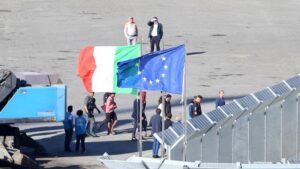
The alliance between rebels and democrats, in this European constituent phase, is fundamental. To understand it and to act on it does not mean watering down our perspective, nor does it mean renouncing key themes such as radical welfare, redistribution, self-government, and freedom of movement. To form alliances means recognizing that the question of Europe requires us to operate within a broader complexity, including with those who today speak of a common defence, European sovereignty, energy independence. Each of these dimensions reflects the crisis of the previous order; therefore, the issue cannot be reduced to mere symbolic gestures, such as planting flags. Rather, it must create broad spaces which, even around these key issues, can point toward the prospect of a radical transformation of Europe: a new constitution, accompanied by a renewed capacity for broad mobilization. The NO KINGS movement in Italy is an example of this.
Finally, as rebels, the crucial point for us remains to define the relationship between cities, territories, and Europe. During the years of globalization, municipalism allowed us not to have to choose between global capital and the nation-state. Today, that line of reasoning must be brought to a new level: cities and territories remain the place where practices, conflicts, welfare, mutualism, and self-government are produced. The question is how can municipalism, communalism, and grassroots activism — in short, the primary arena of action for many comrades — relate with everything else today? We cannot answer this question on our own, and we certainly do not want to do so within the confines of the nation-state. Acting the alliance between rebels and democrats therefore means rearticulating such relationships: cities and Europe, self-government and government, conflict and institution, material constitution and formal constitution.
Not to defend the Europe that exists, but to contest and shape the one that is yet to come. Not on our own, on a European island cut off from the rest of the world, but within the forces of transformation that — especially at this historic moment — we must seek out in global upheavals and in global networks of comrades, starting with the Kurdish confederal project.
European “beyond-democracy“
All that we have described produces, in terms of governance, what we have defined as the quest for beyond-democracy, which is irreversibly affecting liberal democracies. In an effort to reflect on these dynamics, we have sought to adopt new lenses, forged from some of the most heretical reflections within beyond-communism — from Abdullah Öcalan to Donna Haraway, from autonomist thought to radical municipalism, from cyborg and technological activist networks to the multitude against Empire — and we have sought to apply them to our own context. Within the constituent space, we are convinced, new lenses will be combined to free us from the past and engage with the problems of the transition in a way that is even more suited to shifting the balance of power. We believe that the search for the category of beyond-democracy is the right path to take, as democracy as we have known it cannot simply be preserved.
While in Italy, especially at this time, we may still rely on the shield of anti-fascist resistance and the defence of the Constitution against attempts to change it, when it comes to Europe we must not only figure out how to bring together those who stand up resolutely against fascists, that is the Antifa, but also how to free ourselves from the rhetorical constraints of resistance in order to imagine the beyond. Precisely because there is no fully established European constitution to defend, we must address the question of what lies ahead. It is on Europe that we can advance our beyond-democracy and begin to articulate it.
For example: what does it mean today to say ‘No to NATO’, ‘Enough with the United States’? The significance of these statements today is very different from what it was in the past. These are issues that can be championed by rebels, with conviction and a spirit of resistance, knowing that they are far more concrete than in the past and possess a much greater intrinsic power. These are indeed struggles that must be waged with radical determination, yet they are part of a broader European context.
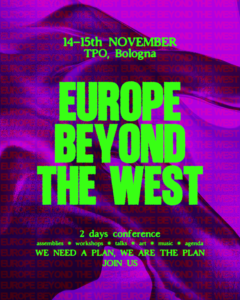
Similarly, let us consider how important it is today to break with the West, to free ourselves from Atlanticism, from our governments’ collusion with other subsystems, from colonial approaches, from the use of power to perpetuate dependencies: we must break with the West in order to build Europe. This would also allow us to find new, concrete terms to define and effectively counter colonialism and imperialism for what they are: from Israeli to Russian forms, to American and Chinese ones, thereby ceasing to refer to a generic Western colonialism but instead identifying in detail the responsibilities of individual European countries and EU institutions as a whole.
Finally, we should continuously investigate how European networks — industrial and technological networks driven by new digital services and cutting-edge scientific knowledge — move within these upheavals, and how class struggle will unfold.
From Europe to China
China needs to be investigated. We do not yet fully understand it, and yet it is a reality that has successfully navigated all the phases we have described. We have said that wars arise from a paradigm shift and from the struggle over who commands in hegemonic form. We are in a phase where beyond-democracy is linked to the capitalism of the beyond-human. Where do we find an already structured form of this relationship? Not in the United States, not in Italy, not in liberal democracies in crisis. We glimpse it above all in China, where there is no problem of going beyond liberal democracy because China is already within a form of post-democracy.
What we are witnessing in recent years is a crisis marked by ruptures, reversals, accelerations, attempts at recomposition, and new fractures, yet driven by powerful and unstoppable forces. It is not a matter of abruptly abandoning all forms of the past and pretending that different forms will not persist for a long time to come. But when powerful forces are in motion, the task is to try to control them and harness them at their most advanced stage in order to change their direction, possibly to plan better, or even — as regards the automated warfare sector as a whole—to know when and how to drastically halt the development of autonomous lethal technologies. But this cannot happen at Europe’s current pace, much less without a political Europe.
Just as Marx, in order to understand the capitalism of his time, looked at the factories of London rather than the remote countryside, today we need to look to China to understand something of the development of beyond-human capitalism in the age of beyond-democracy. We have to examine China’s approach to technology, how it is used socially, not only in terms of control, but also as a field of experimentation. Images of robots and humans running marathons together, of lights-out factories, of implanted chips connected to AI, all of these indicate a direction in automated production.
In the Chinese context, in particular, it would be crucial to grasp what happens in terms of conflict and counter-power. If conflicts emerge there, if new struggles and forms of liberation from labor develop, then we have essential insights for interpreting the future. If, on the other hand, none of this is happening, the problem is enormous: it could mean that the system combining beyond-human capitalism and beyond-democracy — even in its totalitarian forms — can function. And that would be a major problem for everyone. We need to grapple explicitly with these knots. That is why it is essential to examine China, to draw material from there, and to understand its contradictions. We need to understand whether so-called ‘human capital’ can initiate forms of liberation from labour precisely within the most advanced point of the new capitalist form.
Explicit
We write this thesis because we are at a historical turning point, and we want to discuss it with many comrades — rebels and democrats in Europe and beyond — so as not to become merely a subsystem of capitalism that competes through war and expropriation, whether as a nation, a clan, a religious sect, a self-proclaimed millennial Empire, or a company led by Nazis.
We need a shift in perspective, organization, and vision that is commensurate with the new ways of producing, accumulating, and exercising power. This is what leads us today, even more clearly, to seek a new Europe: a Europe that is free from the US and no longer the West, not a sum of nation-states nor a rehash of 20th-century communism, but a new project of liberation capable of existing within the beyond-human and doing so in a different way.
15/05/2026
Municipi sociali Bologna
Spazi sociali Reggio Emilia
Utopia
An alliance between the Europe we have described and a liberated China may seem absurd. But it is an absurdity that we can dream of, by constantly confronting the dream with the changing material reality and with what we will do to transform beyond-democracy into something extraordinary.
This is utopia.