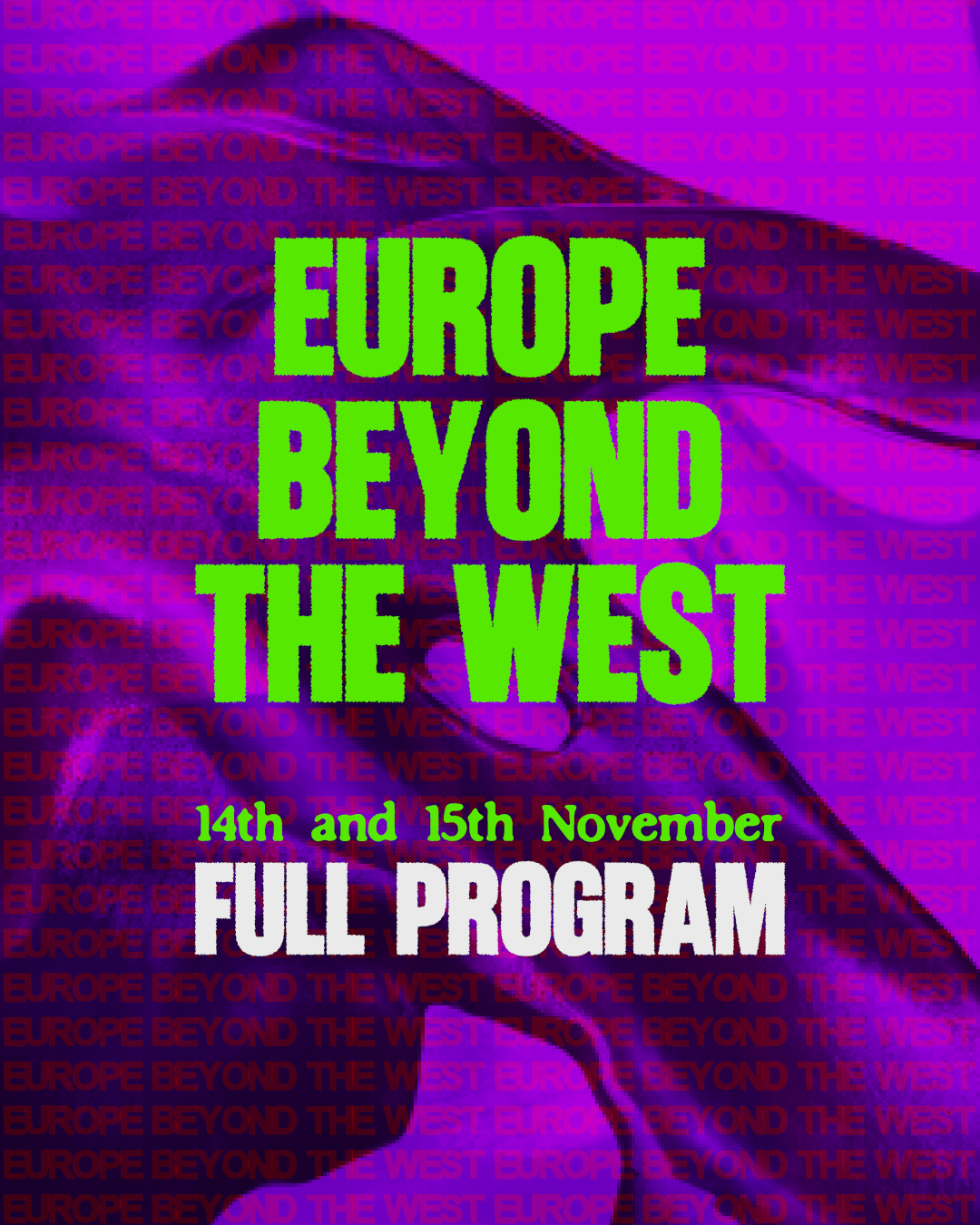
14–15 November 2026, Bologna @ TPO (Via Casarini 17/5)
We call upon a multitude of rebels and democrats who recognize in this European space-time an opportunity to radically transform the existing order. A European congress to conspire together, to confederate our struggles, knowledge and territories, and to begin building our Europe of the future (link to the call).
To participate, register via the online form HERE.
Saturday 14
9.00 – 9.30 – Arrival and Registration
▼ 9.30 – 11.30 – Plenary – Europe beyond the West within the Global Civil War
We live in an era of global disorder in which capitalism has assumed an increasingly direct role in commanding society through algorithmic and automated forms of value extraction. No power, whether state-based, corporate or of another kind, has managed to establish itself as the leading force behind this new regime of accumulation. War, in all its forms (military, financial, civil, and so on), is the instrument through which these powers compete with one another to carve out new spaces of power. Yet this struggle is not simply a confrontation between superpowers: it expresses the fundamental class conflict of our time, marked by the growing concentration of wealth in the hands of a few, who are willing to do whatever it takes to expand it.
From Kharkiv to Ceuta, from Minneapolis to Gaza, from the attacks on A/I and the ICC to Putin’s troll factories, what we are witnessing is a cross-cutting assault on every form of life and resistance, taking the shape of a permanent global civil war.
In this context, Europe finds itself caught between the EU’s crisis-ridden neoliberal project on the one hand, and the rise of authoritarianism and fascism on the other. Yet we are not forced to choose between defending the status quo and retreating into nationalist sovereignty. At this historical juncture, Europe has an unprecedented opportunity to free itself from the yoke of its past, of the United States and of other powers, and to build its own autonomy through the efforts of rebels and democrats, finally dismantling the nation-state form. Madrid, Tirana, Paris, Milan, Berlin, Kyiv and Belgrade are showing us that the other Europe is already here. When Milan rises up to the cry of “Let’s do as they do in Paris, Spain, Belgium and Albania”, it is already crossing national borders and recognising the European space as the minimum horizon of political struggle, because the conditions are shared across this space.
We want to address two fundamental questions.
The first: in Europe, a conflict driven from above is unfolding through war, fascism, patriarchal violence and deportations, the rising cost of living, environmental devastation, algorithmic control, and the erosion of cities, welfare systems and incomes. How should we position ourselves within this constituent conflict and establish Europe’s political, financial, digital and energy autonomy, finally free from NATO and moving beyond the West, but also beyond the influence of other capitalist powers across the globe?
The second: can we use the right to resistance as an overarching political category for defining power relations in the context of permanent global civil war? Rather than siding with one power or another, can we reject calls for rearmament, which serve to reorganise the capitalist system through the conversion of factories, the accumulation of new profits and the testing of increasingly unrestrained technologies, without denying the right to self-defence of every society under attack.
▼ 13.30 – 15.30 – Assembly – Antifascism 2.0 is against remigration
How do we exercise from our territories the right of resistance today?
New authoritarianisms and new fascisms are organizing on a transnational scale. Governments are adding “Antifa” to their lists of terrorist organizations, infrastructures of resistance such as Autistici/Inventati are coming under attack, and in courtrooms those who fight for everyone’s freedom are being criminalized: Gino, Maya and so many others. Nationalist anti-antifascists aspire to hold summits in the heart of Europe to build segregated societies that exclude, deport and suppress anyone who stands in their way. They are constructing the domestic enemy, the antifa, and the foreign one, the migrant. What holds them together is remigration: the fantasy of a purified society, in which whoever exceeds its borders can be exploited, deported or repressed. It is a project for society, but also a new algorithm of cultural identity: a criterion that decides who can be assimilated and who cannot, and that now circulates bare-faced and clean-cut, in party programs as in the languages of communication. From the AfD to Futuro Nazionale, from the Rassemblement National to Vox, the dark international is growing across European space. Therefore, the national space is no longer enough to counter it: we must organize at least on a European level, and deny it any platform to speak.
What, then, does it mean to be antifascist today? We have seen it in recent weeks, from Paris to Milan, from Rome to Berlin, when the Gen Z took to the streets chanting Siamo tutti antifascisti, clearly revealing a shared feeling of being antifascist today, one that is – at least – European in scope. Militant antifascism is alive: it still plays, and has long played, a decisive role in containing street-level neofascists and keeping them in check. This historic militant form of European neofascism and neonazism is going through a deep crisis today, but it has not left the stage. Democratic antifascism has also held up, at least formally: despite enormous limits and deep contradictions, the “cordons sanitaires” meant to contain the far right have managed to isolate extremists and keep them from any real chance of governing. But those cordons could give way, given the strength the electoral far right is gaining and the current reluctance of moderate right-wing parties to take clear positions. What follows is a brief picture of how activity and strength have shifted within the field of right-wing extremism, and it is from this shift that we need to reorient antifascist thought and practice.
Starting from the recognition that antifascism is one part of the movement’s political action, we could also define it as the defensive and destituent part of that action. Defensive, because antifascism is an act of defense against fascism: political, social and even military defense, both historically and today. Destituent, because its task is to prevent nationalist, supremacist and racist ideas from gaining ground in the streets and in society, in the awareness that it is not itself the bearer of the new social and political plan, the one that carries the ideals, ideas and praxis for a radical change of the social system. It is an antechamber to that plan and a prerequisite for it, but not its paradigm.
That plan requires more: a transversal political and social project, and a transformative cultural battle, both rooted in social and class relations and growing out of a contemporary reading of them. This is why we believe it is necessary to come together and ask ourselves how to organize today at the European level to stop the advance of the techno-nationalist far right, and what model of society we want to build against the project of remigration. We look ahead to 2027, a decisive political year in which Europe will need to fight back.
- How do we connect antifascism to the material struggles of our societies?
- What does it materially mean to exercise our right of resistance in Europe today?
- How do we halt the advance of the Black International in our cities, in our territories and across the continent?
- How do we give body and possibility to a new antifascist internationalism of liberation?
- What is the relationship between militant “street” antifascism and the antifascism that steps into electoral moments to draw votes away from the far right?
- How do we turn the practice of antifascism into a cultural battle that brings forth an alternative to the “remigration” society?
Talks – first slot 16.00-17.30
▼ 1. Reclaiming Tech & AI for people and the climate.
The oligopolistic development of the tech sector is directing Artificial Intelligence and new technologies towards capitalist profit, turning data centres into energy-hungry monsters that deepen social and environmental inequalities. We need to reverse this direction: AI and new technologies must serve the common good and the fight against climate change. Not against technology, but for alter-technologies and alter-AI.
Joao Camargo – Climaximo (Portugal)
Joao is organizer in grassroots movement Climaximo (Portugal). Author of The Algorithms of Collapse, organizer of the global action on January 2027 “Down with Data Centers”.
Angela Chukunzira (Kenya)
She works at the intersection of technology, labour and human rights. Her work initially focused on the role of technology within social movements, and examines how digital transformation is shaping the political economy of technology across Africa. She is a former Mozilla Fellow and currently working on well-being economies.
Edward Dickinson – Pull The Plug (United Kingdom)
Edward is Co-Founder of Pull The Plug with wide organisational and international experience who previously played a role in the success of groups such as Just Stop Oil and The A22 Network. Pull The Plug is a nonviolent movement seeking to pull the plug on Big Tech’s undemocratic control of AI, establish a Citizens’ Assembly on AI and build mass mobilisation.
Ashley Dawson (United States of America)
Ashley Dawson is Distinguished Professor of Postcolonial Studies at the City University of New York. He is now working on data center resistance in the US and is the author of books such as Environmentalism from Below.
Moderated by Ludovico Intruglio, Municipi Sociali of Bologna.
▼ 2. From the East, a New Europe.
Thinking of our continent as a space of possibilities means looking towards where things are moving. In recent years, Eastern Europe has emerged as a dynamic terrain of conflict, crossed by war but also by mass social movements that have challenged power and are aiming for regime change. Together with those who have experienced these movements, we ask ourselves what desires and aspirations have driven these different upheavals, and whether we can build our new Europe from the force they have generated, together with those who have carried them forward.
Entenela Ndrevataj and Gresa Hasa – Flamingo Revolution (Albania)
Entenela is an Albanian independent journalist, social worker, feminist and human rights activist. Gresa is an Albanian political academic researcher, feminist activist and independent journalist based in Graz,Austria.
Katarina Jeremić and Jelena Božić – SviĆe (Serbia)
SviĆe is a self-organized grassroots activist group in Serbia working to strengthen democracy, political accountability, and active civic participation. We mobilize citizens to challenge injustice, defend fundamental rights, and drive meaningful social change.
Rozafa Maliqi and Ana Milosavljevic – Balkan Solidarity Network (Serbia – Kosovo)
BSN was originally created in the wake of the genocide in Palestine as an effort to unite pro-Palestine collectives in the Balkans. Now it also works to break down nationalist divisions in the region outside the mainstream political arena.
Vlad Shermazanashvili – Movement for Social Democracy (Georgia)
Founded in February 2025 during the street protests, the movement aims to promote justice and social democracy, which “can only be achieved within Europe”. European integration is therefore seen as part of a broader process involving both the Georgian state and society, in which citizens play a central role through grassroots mobilisation, as demonstrated by the protests. The movement is expected to formally establish itself as a political party around mid-November.
Moderated by Sara Polidoro
▼ 3. Beyond Mutualism: Urban Resistance and European Confederation.
Across Europe, struggles for housing, healthcare, education and a European basic income are building practices of mutual aid, self-organisation and collective resistance. From popular clinics and housing struggles to trade unionism and student mobilisations, these experiences raise a shared question: how can local struggles become lasting infrastructures of resistance and collective power? Moving beyond mutualism as solidarity alone, and the framework of the nation-state, the talk explores the potential of rebellious cities and territories to connect through networks of conflict, cooperation and self-government. How can autonomous spaces and popular institutions defend and expand existing rights while experimenting with new forms of democratic transformation? Can these networks converge into a European confederation of urban and territorial resistance, capable of sharing resources, knowledge and political initiative across borders and building a common political project from below?
Sindacato de Inquilinas de Madrid (Spain)
It is a grassroots organisation that mobilises tenants to defend the right to housing. Through collective organising, mutual support and direct action, it fights rent increases, evictions and housing speculation. It is directly involved in the massive wave of housing mobilisations sweeping across Spain in recent weeks, organising demonstrations and building momentum towards a nationwide strike.
Poliklinik Syndikat (Germany)
The Poliklinik Syndikat is a nationwide network of community-based, solidarity health centres that bring together healthcare professionals and social services to make healthcare accessible to everyone .It works to tackle health inequalities by addressing the social determinants of health and promoting a democratic, collectively organised and socially just healthcare system.
Bartek Kurzyca – Inicjatywa Pracownicza (Ozz IP, Poland)
It is an autonomous, independent Polish trade union affiliated with the International Labour Network of Solidarity and Struggle. Active in sectors including logistics, retail (including Amazon), healthcare, education, and culture. It also organizes youth, students, women, and supports social, environmental, and migrants’ rights movements.
Moderated by Laboratorio di Salute Popolare.
Second slot – 18.00 – 19.30
▼ 4. Ukrainian society in wartimes: from the right to resist, to new social conflicts.
Russia’s full-scale invasion of Ukraine in February 2022 marked a decisive turning point in the new era of global authoritarianism, bringing to light political and social processes that the Western world had tended to ignore. While the West was thrown into disarray by the overt manifestation of Russian imperialism, seeking interpretative frameworks in categories inherited from the past or in the science of the enemy, geopolitics, people, activists and political organisations in Ukraine have had to reckon with the new reality imposed upon them by war. How does one attempt to change the world by exercising the right to resist? How does class conflict evolve, and how can it be fought in a society under martial law? What environmental emergencies have been brought about by the devastation wrought by Putin’s army? What role do cultural policies play? What forms of solidarity can emerge from disagreement rather than consensus? How can collective resistance open up new ways of imagining and inhabiting shared territories?
Solidarity Collectives
An anti-authoritarian volunteer network that unites several individual and organizational grassroots initiatives united to help the Ukrainian resistance movement and people affected by the Russian invasion.
Oleksandr Kyselov
From Donetsk, is a member of Sotsialnyi Rukh (Social Movement), graduated in European Studies from Yerevan State University, he worked as a data analyst at the Sloviansk office of the Right to Protection Foundation and is currently a Research Assistant at the Department of Government at Uppsala University, Sweden.
Valeriia Zubatenko
Multidisciplinary political artist, curator, educator, researcher and essayist with a professional background in human rights and culture. Works through a post-colonial and feminist lens with themes such as the representation of war-related experiences, politics of memory, transgenerational trauma, and artistic research. Actively collaborates with feminist, leftist grassroots initiatives and institutions to raise awareness about the war and genocide in Ukraine.
Valerie Karpan and Maryna Marynichenko – Variable Name
Variable name is a duo of ukrainian artists and сurators, their practice explores urban environments, local histories, collective memory, and the ways people relate to and inhabit shared spaces. Working across artistic research, visual anthropology, and non-formal education, they develop collaborative approaches to memory, communication, and the negotiation of different experiences and perspectives.
Moderated by Silvio Salvemini, Municipi Sociali of Bologna.
▼ 5. From Trump’s OFAC sanctions to the El-Hisrhi case before the International Criminal Court: Europe as a space of rights.
One of the levers of US imperial power over Europe is the repressive use of the monopoly held by digital financial platforms to criminalise and target political dissidents or European institutions, such as the International Criminal Court, that challenge the abandonment of international law as a framework for regulating relations between states. Recent developments, in particular the use of OFAC sanctions imposed by the White House to target individuals, politically “undesirable” collectives, or an international court established to deliver justice to victims of war crimes and crimes against humanity, raise serious questions about the need to rethink Europe through the development of mechanisms to protect against the overwhelming digital and financial power, and therefore the political power, of the American imperial order.
Chantal Meloni
Associate Professor of Criminal Law at the University of Milan and Senior Legal Advisor at the European Center for Constitutional and Human Rights (ECCHR) in Berlin. Her work focuses on international criminal law, war crimes, and individual criminal responsibility for international crimes, including before the International Criminal Court.
Emanuele Braga
Artist, philosopher, and activist, co-founder of MACAO, an independent arts and culture center in Milan, and the Institute of Radical Imagination. His research explores the relationships between economics, labour, digital technologies, and social transformation, with a particular focus on the commons and alternatives to capitalism.
“Nel Mirino” Campaign
A collective mobilisation against the use of US sanctions to target activists, organisations, and digital infrastructures involved in political dissent. The campaign advocates for freedom of expression, European technological and financial autonomy, and the protection of spaces for activism and solidarity.
Moderated by Luca Casarini, Mediterranea Saving Humans.
▼ 6. Urban Climate Activism 2.0 – New Demands and Practices of Struggle to Transform Cities in the Age of Climate Crisis.
The long, hot summer has made one reality tangible for millions of people, one from which there is no turning back: the climate crisis is no longer a future threat, but a material condition shaping our lives, deepening social inequalities and profoundly disrupting cities and environments. How can we turn this shared experience into a new wave of struggles, demands and social transformation, without resigning ourselves to mere survival or adaptation? Urban climate activism seeks to bring together climate and social justice, scientific research, technology and collective mobilisation to concretely transform living conditions. From urban heat islands to tropical nights and wetlands, new scientific knowledge about the transformation of our territories opens up the possibility of inventing new demands and practices of struggle, place by place, capable of bringing together different communities and social groups to claim, here and now, the right to a dignified life.
Salvatore Pappalardo
He is a geographer at the University of Padua. His research investigates climate extremes, urban heat islands and unequal exposure to heat, combining satellite observations, spatial analysis and citizen science. Through participatory action research, he explores how communities can produce scientific knowledge to advance urban climate activism, collective empowerment and just adaptation. He coordinates the GIScience and Drones for Good laboratory and serves on the scientific committee of the Jean Monnet Centre of Excellence on Just Fossil Fuel Transitions.
Elisabetta Tola
She is a science journalist, co-founder of facta.eu, an independent science journalism centre, and formicablu, a science communication agency. She is editor-in-chief at Il BO Live and host of Radio3 Scienza. She is also a media trainer and lecturer in digital science journalism, data and AI. She has co-authored several environmental investigations, often cross-border, including Wasted Wetlands, SwamPower, Under the Surface, Forever Lobbying Project, Green to Grey, and A War on the Biosphere in Gaza. She is co-author of Le ragazze e il colibrì, written with Annalisa Corrado (People, 2026), and Semi ritrovati. Viaggio alla ricerca dell’agro-biodiversità (Codice Edizioni, 2020; Alianza Editorial, 2024). She is also the author and narrator of several podcasts, including She, Green (Chora Media and Il BO Live) and Museo dei Futuri (RAI Radio3).
Gianfranco Bettin
Born in Porto Marghera, he has taught and worked in the fields of socioeconomic research and political studies. As social and environmental activist, he is the author of novels and essays, including Cracking (Mondadori, 2019) and I tempi stanno cambiando. Clima, scienza, politica (e/o, 2022). In 2021, he edited the anthology Profezie verdi. Le origini del pensiero e dell’azione ecologista for the Fondazione Giangiacomo Feltrinelli. He also co-authored La strage degli innocenti (2019) and La tigre e i gelidi mostri (2023) with Maurizio Dianese, both published by Feltrinelli.
Moderated by SCIFT (Laboratory of Science, Climate Activism, Imagination, Education and Technology)
Sunday 15
09.00 – 11.30 – Workshops
Building on Saturday’s discussion, participants from across Europe will meet to share know-how, create convergences, and discuss practices. We are identifying different Working Groups based on concrete fields of intervention. More workshops could be added in the next weeks.
- Collective resistance to digital surveillance
- Against migrant detention, deportation and racial violence
- Conflictual mutual aid (popular clinics, the right to housing, urban trade unionism, education)
- Anti-fascist networks and campaigns
12.00 – 14.00 – Assembly – We are the Plan – Make our Europe beyond the West
Building on Saturday’s discussions and Sunday morning’s working groups, we will develop our organizational common plan and agenda. Let’s build our Europe and put an end to Kings, wars and systemic chaos.
People coming from (updating list):
Academy of Democratic Modernity
Allt åt alla (Swiden)
Algorithms of Revolution
Balkan Solidarity Network
Bolt Cutters (Germany)
BreakFree (Swizerland)
Climaximo (Portugal)
COG-U – Sindacato del Cognitariato (Italy)
Debt for Climate
Ende Gelände (Germany)
European Alternatives
eurobox ETS (Italy)
Feministisches Streikkollektiv Zürich (Swizerland)
FLAM – Fronde Liégeoise anti-militariste (Belgium)
Flamingo Revolution (Albania)
Inicjatywa Pracownicza (Poland)
Interventionistische Linke (Germany)
Kino Plausch (Germany)
Kurdish Women Movement
Movement for Social Democracy (Georgia)
Municipi Sociali di Bologna (Italy)
“Nel Mirino” Campaign
NINA Watch (Italy)
OAT (Zürich)
OBC Transeuropa
Ostro
Pelican Collective (UK)
Period Think Tank (Italy)
Plan C (UK)
Poliklinik Syndikat (Germany)
Pull The Plug
Queers for Palestine
Ronahî
SCIFT – Laboratory of Science, Climate Activism, Imagination, Education and Technology (Italy)
Sindicato de Inquilinas de Madrid (Spain)
Solidarity Collectives (Ukraine)
Sotsialnyi Rukh (Ukraine)
Stop Rearm Europe
Students for Palestine of the Faculty of Humanities and Social Studies in Zagreb (Croatia)
Sviće (Serbia)
TOP Berlin (Germany)
Ultima Generazione (Italy)
Ujedinjeni protiv fašizma – United Against Fascism (Croatia)
Variable Name – Назва змінна (Ukraine)
Verein Theater der Unterdrückten (Austria)
Woman, Life, Freedom Movement (Belgium)
Zero81 (Italy)